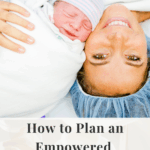
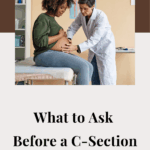
Someone asks how the birth went, and you brace before you even answer. “It was a C-section,” you say, and you watch their face do the thing: the small pause, the “oh,” the sympathy for something you never asked to be pitied for. You find yourself explaining, unprompted, like the delivery method needs a defense attorney. You catch yourself doing it again at the pediatrician’s office, at a baby shower, in line at the grocery store when a stranger asks if you “got to” try for a natural birth.
You didn’t imagine that reaction. It’s real, and it’s exhausting, and it has nothing to do with whether your birth went the way it needed to. Performing the acceptable version of your own story instead of the true one shows up everywhere in this season, not just in this one conversation.
Why does a C-section feel like it needs defending?
Because you were taught, probably in a childbirth class taught with the best intentions, that C-sections are something to avoid at all costs, a fallback, a failure of the “right” kind of birth.
I heard that exact message in my own birthing class, from a labor and delivery nurse who meant well. She wasn’t trying to scare anyone. She was teaching what she’d been taught herself: that a vaginal birth was the goal, and a C-section was the thing you tried everything to avoid. Then at 35 weeks, my baby turned breech, and every plan I’d built dissolved. The anger wasn’t really about losing the birth I’d prepared for. It was about being funneled, without my consent, toward the outcome I’d already been taught to fear, and being handed no honest information about why that fear didn’t hold up.
Why do you do everything possible to avoid a C-section, even once it’s not really the problem anymore?
Because the fear was never really about surgery. It was about what surgery was supposed to mean about you, about your body, about whether you’d tried hard enough to avoid it.
I spent four weeks trying everything: handstands in a swimming pool, lying upside down on an ironing board, a hot bath with an ice pack balanced on my very pregnant stomach, an external cephalic version with four doctors attempting to manually turn my daughter from outside my body. None of it worked. I spent that entire month worried and obsessed, time I will never get back, time that should have gone toward enjoying the last weeks of pregnancy instead. And afterward I felt the need to apologize every time someone asked about the delivery, as if a c-section were a “had to” instead of a “how it went,” as if I owed the world an explanation for a decision that was never mine to be ashamed of.
Is a planned C-section for a breech baby the safer choice?
Often, yes. The Term Breech Trial, a large international randomized trial, found that a planned cesarean significantly reduced the risk of perinatal death and serious newborn complications compared to a planned vaginal delivery for a breech baby at term, with no meaningful difference in complications for the mother. Current medical guidance reflects this directly: offer an external cephalic version first, and if that isn’t successful or isn’t right for you, a planned cesarean after 39 weeks is the standard recommendation, not the fallback option.
That’s the actual data behind the decision that so often gets treated like a consolation prize instead.
Is choosing a C-section giving up, or is it something else?
By my second pregnancy, my OB was completely supportive either way. “You’re healthy. There’ve been no complications. I’m open to a VBAC or a C-section, whatever you choose,” she told me. And I still couldn’t decide, because the pressure wasn’t coming from her. It was coming from every birthing class, every natural-birth account, every version of what I thought other people would think if I chose surgery instead of needing it.
My husband and I built a decision-making tool together, writing out every medical, emotional, and logistical factor on sticky notes, one per column, trying to make an impossible choice feel like something we could see and sort. At the end, the only note still sitting in the VBAC column said “because I should.” Because it was supposed to be the redemption arc for my first birth. Because I didn’t want anyone thinking I’d taken the easy way out. Not one note in that column was about what I actually wanted, or what my body actually needed, or what would genuinely be safest for either of us. I took that note down. I chose a scheduled C-section, and it turned out to be the right call for me, not because it was the harder or easier path, but because it was actually mine, made with clear eyes instead of borrowed shame.
How do you know if your provider respects your choice?
You’ll hear it in the language. “We’ll let you try” and “we’ll see how it goes” both treat you as someone waiting for permission, someone whose plan is provisional until proven otherwise. “We’ll support whatever path you choose” and “let’s build a plan that feels right for you” treat you as the person making the decision, full stop. Notice which version shows up in your own appointments. If you keep hearing the first kind of language from someone who’s supposed to be your partner in this, it’s worth finding someone who speaks the second kind instead, even this late in the process. You’re hiring this person for one of the most consequential days of your life. Interview them like it, and don’t apologize for asking hard questions.
What changes once you stop treating your C-section as something to explain?
You stop measuring your birth against a version that was never available to you, and you start measuring it against what it required: a decision made with real information, under real pressure, that you’re allowed to call yours without qualification. That gap between the birth you were sold and the one you actually had shows up everywhere in this season, not just in the delivery room. Your body didn’t fail. Your provider or your birth class may have failed to prepare you for this specific outcome. You made the best call you could with what you actually had, the same way you’re making every call this season with the information in front of you, not the version you wish you’d had. That’s a truer story than the one you were promised, and it’s the only one that was ever really yours to tell.
Ready to stop explaining your birth?
You’ve probably already spent real time rehearsing the short version of your birth story, the one that doesn’t invite a follow-up question or a sympathetic tilt of the head. Postpartum Rise was built for the reckoning underneath that: it shows you the specific pattern that turned a medical decision into something you feel you owe people an explanation for, and introduces you to the woman who made that call, on purpose, with the information she had.
Postpartum Rise ($97) is one guided hour that gives you what all that rehearsing hasn’t: language for what actually happened, and a real look at the woman who made the call.
P.S. If a full Rise session is more than you have room for today, Postpartum Daily Reset ($9) is a five-minute version built for the days you can’t get to anything longer.