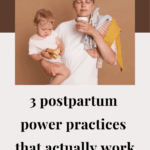
You’re Not Behind, You’re Becoming: Why Postpartum Slowness Is Strategic
Everyone talks about how hard postpartum is.
The sleepless nights. The body that feels foreign. The emotions that come out sideways.
But no one talks about the shame spiral that starts when your brain doesn’t work like it used to.
You forget what day it is. You re-read the same email four times. You find yourself staring at your laptop, trying to form a single coherent sentence—and it won’t come.
You snap at your partner. You forget to pay the preschool deposit. You wonder if you’ve lost your edge completely.
And under all that swirl is one sticky thought:
I’m behind. I’ll never catch up. I used to be so sharp.
But what if that fog isn’t failure?
What if it’s the beginning of a completely new kind of clarity?
The Invisible Pressure to Perform
By the time most U.S. moms return to work—just 12 weeks after giving birth—they’re expected to function like nothing’s changed.
Never mind that their organs just rearranged. That they’re waking up three times a night. That they’re still bleeding, still pumping, still physically recovering from what, for many, was the most intense experience of their lives.
Return-to-work culture assumes full capacity by week 13. It expects presence, precision, and productivity. And if you’re lucky enough to work from home, the pressure to “prove you’re still all in” can be even worse.
Then there’s social media:
- The 5am CEO moms
- The “back in my jeans” transformation reels
- The 2-week postpartum founders leading investor meetings with a baby on their chest
You scroll. You compare. You wonder why your brain still feels slow.
Why your to-do list is untouched. Why your ambition feels distant, like something you remember but can’t access.
It’s not just that you feel slow. You feel like less.
Like the fog is proof you’re falling behind. Like if you were really capable, really strong, really ambitious, you’d be back to “normal” by now.
What’s Actually Happening in Your Brain
Here’s what no one tells you:
You’re not broken. You’re not weak. And you haven’t lost your edge.
You are becoming neurologically different—by design.
A groundbreaking 2016 study published in Nature Neuroscience showed that during pregnancy and postpartum, women’s brains undergo measurable structural changes. Researchers found that gray matter volume decreases in specific regions—particularly those tied to social cognition, emotional regulation, and empathy.
That might sound scary, but it’s not. The reduction isn’t damage—it’s refinement.
These neural shifts allow for sharper attunement to others, deeper connection, and more efficient emotional processing. Think of it as pruning: your brain is cutting what’s no longer essential to strengthen what matters most.
You’re not losing function. You’re recalibrating.
This explains why data entry feels impossible, but you instantly detect when your baby’s cry is different.
Why responding to emails takes forever, but you can read your partner’s mood with one glance.
Why small talk feels exhausting, but you’re tracking everyone’s emotional temperature like a hawk.
This isn’t dysfunction.
This is evolution.
You are becoming more attuned, more relational, more strategic—just not in ways capitalism celebrates.
Reframe: This Isn’t a Productivity Dip—It’s a Pattern Break
Our culture treats productivity like morality.
We’re told that fast is good. Busy is best. Rest is indulgent. Stillness is lazy.
So when postpartum hits—and your pace slows to a crawl—it feels like failure.
But here’s the truth:
Postpartum slowness is not a flaw. It’s a feature.
Your body slows you down for a reason. The fog, the fatigue, the need for stillness—they are evolutionary tools designed to protect the most important transformation you’ll ever go through.
You’re not just healing from birth. You’re reconfiguring everything:
- Your relationship to time
- Your relationship to your work
- Your relationship to your body, your family, your ambition, your voice
You’re not recovering—you’re integrating.
And integration takes time.
Capitalism wants you to bounce back.
Postpartum invites you to grow forward.
The slowness isn’t the obstacle.
It’s the space in which something entirely new can emerge.
Three Postpartum Power Practices (Not Productivity Hacks)
Let’s be clear: This isn’t a post about optimizing your output.
This is about reclaiming your experience and honoring the transformation that’s happening beneath the surface.
Here are three simple, radical practices to help you realign with your postpartum power—not rush past it.
1. Reverse Planner
At the end of each day, instead of listing what you didn’t do, list what you did.
- Changed 9 diapers
- Reheated coffee 3 times
- Rocked baby to sleep 5 times
- Scheduled one appointment
- Cried in the shower
- Responded to one email
- Took a deep breath before answering a toddler tantrum
You’re doing so much invisible work. This practice is a way to honor it.
2. Integration Hour
Once a week, carve out one hour—no productivity required.
Just a notebook, maybe a candle, and one question:
What’s changing in me?
Let the answers come without judgment. You are not trying to fix anything. You are listening.
Integration requires witnessing.
You might uncover grief, anger, softness, vision, or something else entirely.
Whatever comes up—it belongs. This is how you learn to move forward without abandoning yourself.
3. Rebuild Ritual
Forget elaborate morning routines.
Choose one daily cue that helps you reconnect to who you are now:
- A word: “Whole,” “Unhurried,” “Sovereign”
- A song: One that brings you back to center
- A breath: One deep inhale before reaching for your phone
- A grounding: Bare feet on the floor, a hand on your heart, one whispered intention
This isn’t about setting the tone for a productive day.
It’s about reminding yourself:
I get to choose how I move, who I listen to, and who I’m becoming.
If you need support with a simple structure, try the Daily Reset for postpartum moms. It’s a 5-minute practice to help you clear your head and reconnect—especially on the messy days.
Who You Get to Be – The Grounded One
You don’t have to go faster. You don’t need to prove your value. You don’t need to chase the person you were before.
You are not behind. You are becoming.
You get to slow down and build something better—on purpose.
Not because you’re lazy. Not because you “lost your edge.” But because you’re learning to use it differently now.
Slowness postpartum is not disconnection—it’s recalibration.
It’s the deep pause required for an identity to take root.
You are shedding what no longer fits. You are choosing what stays.
✍️ Power Paragraph Prompt
Take five minutes today. Write a short paragraph answering this:
What do I want to bring forward from this postpartum pace?
Is it more rest? More boundaries? More softness? More strategy?
Is it the clarity that comes from saying “no” without guilt?
Is it the ability to listen to your body without apology?
Write it. Re-read it. Return to it.
That is your power. That is your becoming.
Ready to Rebuild?
You’re not here to bounce back. You’re here to rebuild with intention and power.
Start now with the Rebuild & Rise audio experience—just $27 for the first 100 spots.
Need 1:1 support? Book your Rebuild Intensive—90 minutes to reconnect and realign.
Need a quick win? Try the 5-minute Daily Reset—a simple mental reset for overwhelmed moms.
Not ready to buy? Download the free Postpartum Reset Guide to start small, today.
You Might Also Like
- The Postpartum Mental Load Isn’t Personal—It’s Policy
- Rebuild Your Morning Routine—One Breath at a Time
- Millennial Mom Burnout: Why We’re More Exhausted After Baby